Dissemination of New Regulations, Pupuk Indonesia Ensures Subsidized Fertilizer Ceiling Price Applies at Handover Point
-
 Posted by User01
- Share


PT Pupuk Indonesia (Persero) ensures that the distribution of subsidized fertilizers to registered farmers at designated delivery points is conducted in accordance with the applicable highest retail price (HET). HET is the purchase price of subsidized fertilizers for registered farmers at delivery points as determined by the government.
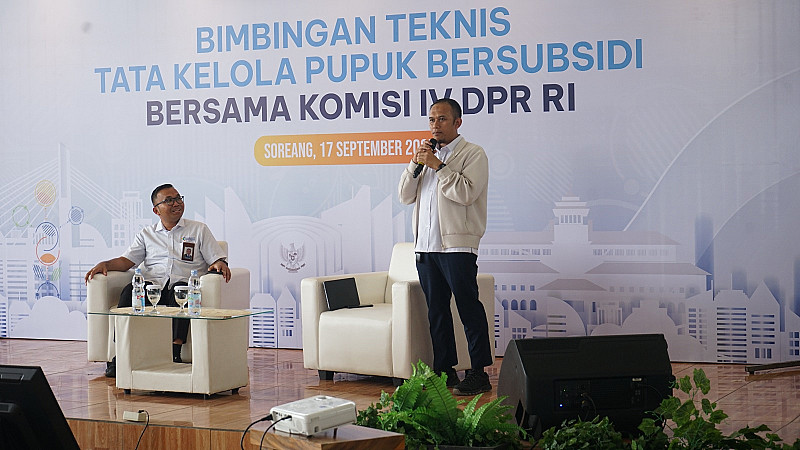
"The HET for subsidized fertilizers applies to collection at designated delivery points, which currently include four entities: retailer kiosks, farmer group associations (gapoktan), fish farming groups (pokdakan), and appointed cooperatives — not for home deliveries," said Deni Dwiguna Sulaeman, Senior Vice President (SVP) of Sales Strategy & Customer Service at PT Pupuk Indonesia (Persero), during the Socialization and Technical Guidance on the Procedures for the Distribution of Subsidized Fertilizer held in collaboration with Commission IV of the Indonesian House of Representatives (DPR RI) in Bandung Regency, Wednesday (September 17, 2025).
As per regulations, the HET for subsidized fertilizers is as follows: Urea fertilizer at IDR 2,250 per kilogram (kg), NPK at IDR 2,300/kg, Special NPK for Cocoa at IDR 3,300/kg, and organic fertilizer at IDR 800/kg. Deni also emphasized that if there are additional delivery charges, they must be invoiced separately.
“For registered farmers, it must be ensured that redemption is done at HET at kiosks. If there are additional charges such as delivery fees or group contributions, the redemption invoice must be separated. For example, if the price of one sack of Urea is IDR 112,500, and the delivery cost is IDR 20,000 per sack, do not make a single transfer of IDR 132,500. The payment for fertilizer and the delivery fee must be made separately,” he explained.
Deni further stated that Pupuk Indonesia is committed to distributing subsidized fertilizer based on the 7 Right Principles (Right Type, Quantity, Price, Place, Time, Quality, and Recipient). Therefore, if any Subsidized Fertilizer Distribution Points (PPTS) are found violating the HET, Pupuk Indonesia will not hesitate to impose sanctions, including license revocation or closure.
To prevent such violations, Pupuk Indonesia has also implemented preventive measures through regular education and outreach to all PPTS. The company routinely issues circular letters on the obligation to distribute according to HET and provides intensive assistance to PPTS.
Additionally, the company invites local governments, law enforcement agencies, farmers, and the public to jointly monitor and report any suspected irregularities in the field. This is to ensure that subsidized fertilizers are received by farmers in accordance with regulations, supporting the national food self-sufficiency goal in line with the aspirations of the President of the Republic of Indonesia, Prabowo Subianto, as outlined in the Asta Cita vision.
At the same event, member of Commission IV of the DPR RI, Rajiv, continued to encourage and support improvements in the governance of subsidized fertilizer. His hope is that the distribution process from producers to farmers will be transparent. He therefore called on all stakeholders to participate in monitoring the distribution of subsidized fertilizer to achieve food self-sufficiency.
“I can’t do this alone. I need the Deputy Regent, the Chief of Police, and the Military District Commander. Let’s start fixing things from Bandung Regency so we can achieve food self-sufficiency. I would be embarrassed if finding subsidized fertilizer in Bandung Regency becomes difficult, even though Pupuk Indonesia has ample stock,” Rajiv emphasized.
He also added that the outreach in collaboration with Pupuk Indonesia aims to increase farmers’ knowledge and understanding of the subsidized fertilizer distribution mechanism, particularly at PPTS.
“During a previous recess, several farmers said they came to the kiosks with their ID cards (KTP), but they couldn’t redeem fertilizer. Upon checking, it turned out they weren’t registered in the Definitive Group Needs Plan (RDKK). Farmers must be registered in the RDKK to be eligible to redeem subsidized fertilizer,” he said.
Meanwhile, the Deputy Regent of Bandung, Ali Syakieb, stated that this outreach is crucial because it concerns the basic needs of farmers — the orderly, targeted, and effective availability of subsidized fertilizers. He believes that this activity is a tangible sign of concern for the advancement of the agricultural sector, which is a priority in the Bandung Regency government's development agenda.
“With this activity, we hope the distribution of subsidized fertilizers will be more effective and have a real impact on agricultural productivity, which in turn will strengthen national food security,” he said.