Pupuk Indonesia Builds the First Soda Ash Factory in the Country
-
 Posted by User01
- Share


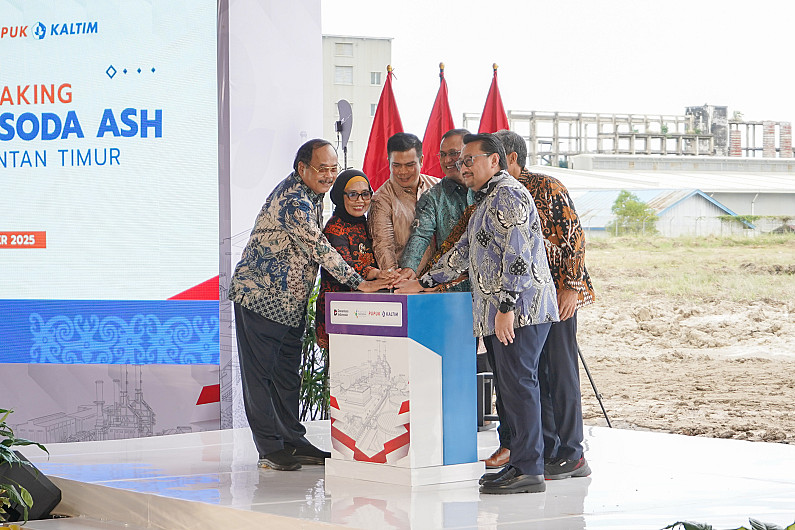
Pupuk Indonesia Group, through its subsidiaries PT Pupuk Kalimantan Timur (Pupuk Kaltim) and PT Rekayasa Industri (Rekind), today officially began the construction of Indonesia’s first soda ash plant.
The commencement of construction was marked by a groundbreaking ceremony, held at the Kaltim Industrial Estate (KIE) area in Bontang, East Kalimantan, on Friday, October 31, 2023. The event was attended by the Senior Director of Business Performance & Assets Optimization of Danantara Asset Management, Bhimo Aryanto, the boards of directors and commissioners of Pupuk Indonesia and Pupuk Kaltim, as well as representatives from the East Kalimantan Provincial Government and the Bontang City Government.
President Director of Pupuk Indonesia, Rahmad Pribadi, stated that this development marks a new chapter in the long journey of the national fertilizer and petrochemical industry, which has grown since the establishment of Indonesia’s first fertilizer plant in 1959. It also represents a significant step toward advancing the downstreaming of strategic chemical industries and achieving a sustainable, low-emission transformation.
“This morning, we are witnessing a historic milestone for the national industry — the groundbreaking of Indonesia’s first soda ash plant. The event also coincides with the first-year milestone of the administration of President Prabowo Subianto and Vice President Gibran Rakabuming Raka,” said Rahmad Pribadi.
Rahmad explained that the construction of this plant represents a concrete commitment from the Pupuk Indonesia Group to strengthen industrial downstreaming and national self-sufficiency, in line with the Asta Cita vision of the Prabowo–Gibran administration. By utilizing carbon dioxide (CO₂) byproducts from existing ammonia production facilities, the plant will produce high value-added chemical products — soda ash — which is essential for various national industries such as glass, detergent, food, pulp and paper, ceramics, and more.
When fully operational, the plant will have a production capacity of 300,000 metric tons per year and is expected to meet about 30% of Indonesia’s national soda ash demand, which is currently still reliant on imports. This reduced dependency is projected to save up to Rp 1 trillion per year in foreign exchange from soda ash import substitution, and about Rp 250 billion per year from ammonium chloride import substitution — a byproduct of the soda ash production process.
“Hopefully, Indonesia’s great dream of becoming more self-reliant and having stronger industrial resilience through import reduction can be achieved. This is our contribution to Indonesia — innovating for the future,” said Rahmad.
President Director of Pupuk Kaltim, Gusrizal, added that the soda ash plant construction aligns with the government’s policy direction under the Asta Cita vision and plays a crucial role in supporting industrial downstreaming and national chemical industry independence. He further stated that the project reflects Pupuk Kaltim’s transformation and business diversification strategy toward a broader, more efficient chemical portfolio that adheres to Environmental, Social, and Governance (ESG) principles.
“This project demonstrates Pupuk Kaltim’s commitment to implementing ESG principles and a circular economy, in which CO₂ emissions from existing plants are reused as the main raw material for soda ash production. We ensure that the entire construction process is carried out under the highest safety and quality standards, as part of our responsibility to deliver an efficient, safe, and competitive industry,” said Gusrizal.
The soda ash plant will play an important role in supporting Indonesia’s Net Zero Emission (NZE) 2060 agenda, as it is projected to absorb around 174,000 tons of CO₂ per year from existing facilities to be used as the main raw material for soda ash production. Through the circular economy approach, these emissions will be converted into value-added products that strengthen the supply chain of various domestic industries. In addition, the byproduct of soda ash production — ammonium chloride — can also be used as a fertilizer raw material, supporting national food self-sufficiency efforts.
Beyond contributing to the transition toward a low-carbon industry, the soda ash plant’s construction is expected to generate broad economic impacts, both regionally and nationally. The project will create employment opportunities during both the construction and operational phases, engage local industries in supplying soda ash raw materials such as industrial salt, and promote local MSME (micro, small, and medium enterprise) empowerment around the industrial area.
Senior Director of Business Performance & Assets Optimization at Danantara Asset Management, Bhimo Aryanto, expressed Danantara’s support for the soda ash plant construction. He stated that the project is not merely a business investment but also an investment in the nation’s future, aligned with the spirit of economic transformation toward Golden Indonesia 2045.
“Pupuk Indonesia Group continues to innovate in developing efficient, low-emission, and sustainable industries. This project not only establishes a new industrial sector but also optimizes existing resources and significantly reduces industrial waste. We aim for this plant to become a new benchmark for Indonesia’s green chemical industry,” said Bhimo.
For Pupuk Indonesia Group, the construction of the soda ash plant is a tangible contribution to strengthening national industrial and food security — both of which are key pillars of Indonesia’s economic sovereignty. With the spirit of innovation and downstreaming, Pupuk Indonesia Group remains committed to continuously enhancing national competitiveness through sustainable, future-oriented industrial development.