Pupuk Indonesia, PETRONAS Chemicals Group Berhad, And Brunei Fertilizer Industries Launch Southeast Asia Fertilizer Association (SEAFA)
-
 Posted by User01
- Share


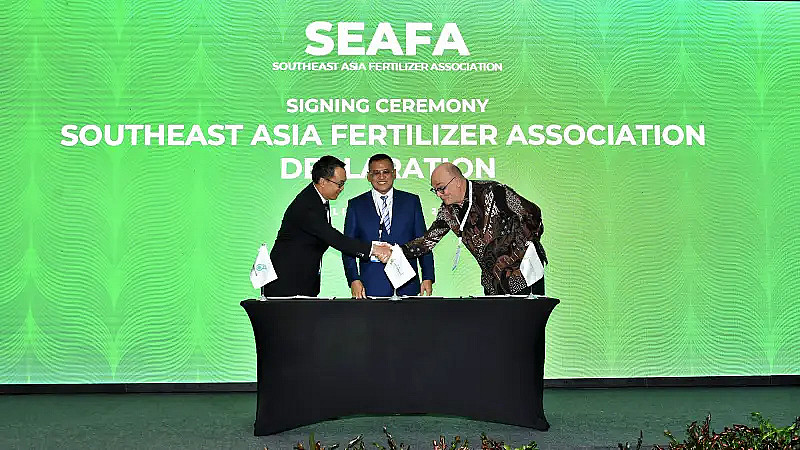
Bali, April 2, 2026 – PT Pupuk Indonesia (Persero), together with Petronas Chemicals Group Berhad and Brunei Fertilizer Industries, has officially established the Southeast Asia Fertilizer Association (SEAFA). The association, formally declared during the Argus Fertilizer Asia Conference on Wednesday (April 1), aims to promote collaboration among fertilizer producers in ASEAN to safeguard regional food security while strengthening the role of Southeast Asia’s fertilizer industry at the global level.
This collaboration is expected to have a positive impact on strengthening the national fertilizer industry. Through regional cooperation, Indonesia has the opportunity to expand access to industrial technology development, increase production capacity, and strengthen a more resilient fertilizer supply chain amid global market dynamics. Ultimately, this is expected to support efforts to maintain fertilizer availability for the national agricultural sector while enhancing the competitiveness of Indonesia’s fertilizer industry at both regional and global levels.
“What we are witnessing today is not merely a signing ceremony, but a step toward long-term growth and progress for the region. The establishment of SEAFA stems from a simple understanding that the challenges in the regional agricultural and food security landscape are becoming increasingly complex. Addressing these challenges requires better information, greater awareness, and a shared sense of responsibility from all of us,” said President Director of Pupuk Indonesia, Rahmad Pribadi.
Rahmad also stated that the formation of SEAFA is an important step for the regional fertilizer industry in responding to global challenges, particularly the rising geopolitical tensions in the Middle East. According to him, this collaboration can strengthen regional industrial synergy in ensuring supply availability to support regional food security.
“As global dynamics continue to evolve—marked by volatile supply chains and shifting energy demands that impact the agricultural sector—it is essential for us to remain adaptive. This is crucial to maintain agility while ensuring that every step we take remains grounded in the principles we uphold,” Rahmad added.
In its initial phase, SEAFA was established by three fertilizer producers in Southeast Asia: Pupuk Indonesia from Indonesia, Petronas Chemicals Group from Malaysia, and Brunei Fertilizer Industries from Brunei Darussalam. Under the agreement, the members decided that Brunei Darussalam will host the association’s main secretariat office. In terms of organizational structure, Pupuk Indonesia has been appointed as SEAFA’s first Chairman, with Petronas Chemicals Group serving as Co-Chairman. The chairmanship will rotate annually among members.
Going forward, SEAFA is expected to evolve into a strategic collaboration platform for the regional fertilizer industry, including serving as a forum for sharing knowledge and innovation in sustainable production practices, low-carbon technology development, and fertilizer supply chain digitalization.
The organization is also expected to represent Southeast Asia’s fertilizer industry in various regional and international forums related to food security, sustainable industry, and climate change agendas.
In the long term, SEAFA is open to expanding collaboration with more fertilizer producers from other ASEAN countries. This is expected to strengthen regional industry synergy and enhance ASEAN’s contribution to maintaining fertilizer supply stability and global food security.
On the same occasion, Indonesia’s Deputy Minister of Agriculture, Sudaryono, emphasized that inter-country collaboration is key to maintaining food security, especially amid global geopolitical dynamics. Such cooperation needs to be built sustainably, including through international forums that bring together various stakeholders, including partner countries.
“We want to build this relationship well—not just for short-term needs. Fertilizer is not only about the fertilizer industry, but also closely related to food security. Therefore, we cannot move independently; we must collaborate across countries,” he said.