Sustainability
Employee Support
1. Labor Practices
Pupuk Indonesia is committed to supporting the Sustainable Development Goals (SDGs) by ensuring the health and well-being of all employees and protecting all workers from any form of excessive exploitation. This commitment applies across all operational activities and serves as the foundation for managing employment relations.
Compliance with applicable laws, regulations, and internal policies is maintained through two key mechanisms:
Periodic Wage Reviews and Adjustments
Wages are reviewed periodically to ensure they remain competitive and comply with the principles of Decent Living Needs (Kebutuhan Hidup Layak or KHL) in accordance with applicable regulations. Wage adjustments take into account the following factors:
- Company performance
- Inflation
- Cost-of-living index
- Applicable Regency/City Minimum Wage standards in each operational area
As a result, all employees receive remuneration above the applicable minimum wage requirements, reflecting the Company’s commitment to supporting the SDGs by providing fair, decent, and sustainable income.
Monitoring of Working Hours and Overtime Management
| Provision | Limit |
|---|---|
| Normal working hours | 40 hours per week |
| Maximum overtime hours | 56 hours per month |
Working hours and overtime are monitored periodically and regularly reported through the Overtime Performance Report, which serves as the basis for evaluating working-hour effectiveness and employee performance. This policy aims to protect employees from excessive working hours while ensuring healthy, productive, and sustainable human resource management.
Overtime limits are established to prevent excessive fatigue, safeguard employee health and safety, and maintain productivity. Employees who work beyond normal working hours are entitled to overtime compensation and rest periods in accordance with applicable laws, regulations, and Company policies.
Overtime Compensation and Adequate Rest Periods
The Company ensures that employees who work beyond normal working hours receive fair overtime compensation and adequate rest periods in accordance with applicable laws, regulations, and Company policies. Overtime hours are controlled to prevent excessive fatigue, safeguard employee health and safety, and support sustainable productivity.
Equal Compensation Ratio of 1:1
Pupuk Indonesia monitors compensation equality for all employees, regardless of gender or other backgrounds. All annual compensation adjustments undergo a calibration process to ensure transparency, fairness, and the prevention of wage discrimination.
The principle of equal remuneration is applied to male and female employees performing the same work or work of equal value, as reflected in the 1:1 compensation ratio achieved in 2025. This commitment aligns with the principles of Diversity, Equity, and Inclusion (DEI).
Annual Leave Entitlement: Work-Life Harmony
- Annual leave is provided as paid leave, ensuring that employees continue to receive their regular income during their leave period.
- Company policies ensure that annual leave requests are not arbitrarily restricted or rejected by supervisors without valid justification.
- Employees are encouraged to utilize their annual leave entitlements as part of their physical and psychological recovery.
Consultation and Notification Regarding Employment Changes
In the event of operational or organizational changes that significantly affect the workforce, including mass layoffs, Pupuk Indonesia prioritizes social dialogue with employees and/or their representatives. Notifications are provided within an appropriate timeframe in accordance with applicable laws and regulations, collective bargaining agreements, and internal Company policies.
The consultation process covers:
- Reasons for the proposed changes
- Scope of the changes
- Potential impacts on employees
- Planned implementation timeline
- Alternative mitigation measures to minimize adverse impacts on employees
2. Labor Practices Programs
Implementation of Labor Practices: Measurable, Monitored, and Demonstrated
Pupuk Indonesia implements measurable and continuously monitored labor practices programs to ensure that its commitments to fair and responsible employment practices are effectively implemented across all operational activities.
Remuneration: 1.83 Times the Minimum Wage
The Company’s remuneration structure and levels are reviewed periodically, taking into account job grades, competencies, individual performance, regional conditions, inflation, cost-of-living indices, and applicable Regency/City Minimum Wages (UMK) in each operational area. These reviews aim to ensure that employee remuneration remains competitive and supports decent living standards. In 2025, the Company’s average lowest wage was 1.83 times the applicable regional minimum wage.
Social Protection Beyond Mandatory Requirements
Pupuk Indonesia provides employees with coverage under BPJS Kesehatan (National Health Insurance) and BPJS Ketenagakerjaan (Employment Social Security), complemented by additional private health insurance benefits. These supplementary benefits enhance financial security, protection, and overall well-being for employees and their families.
Employee Wellbeing and Work-Life Harmony
- Paid annual leave is guaranteed for all employees, and its utilization is monitored as part of the Company’s Employee Wellbeing initiatives to support physical and psychological recovery.
- Family home visit programs are provided for employees on assignment or secondment to help maintain a healthy balance between professional responsibilities and family life.
Harmonious Industrial Relations
Regular communication and consultation are maintained through Bipartite Cooperation Institutions (LKS Bipartit), involving labor unions, as well as Management–Employee Town Hall forums. Key topics addressed through these engagement mechanisms include:
- Wages and employee welfare
- Working conditions
- Occupational health and safety
- Freedom of association
- Equal opportunities
- Career development
Workforce Readiness for Low-Carbon Operations
In response to industrial transformation, digitalization, increasingly stringent environmental standards, and the transition toward low-carbon operations, Pupuk Indonesia provides training, reskilling, and upskilling programs, including:
- Greenhouse Gas Data Management Systems (ISO 14064-1)
- Implementation of Nature-Based Solutions
- Environmental Awareness: Climate Change
- ESG Auditing
- Wastewater and Hazardous Waste (B3) Management
- Environmental Impact Assessment (AMDAL)
- Professional Certifications in Environmental Management and Sustainability
Pupuk Indonesia’s approach to labor practices extends beyond regulatory compliance by promoting employee well-being, strengthening social protection, enhancing productivity, fostering harmonious industrial relations, and supporting long-term workforce sustainability.
Employee Diversity
Inclusion as a Key to Sustainability
Pupuk Indonesia believes that diversity and inclusion are key to achieving sustainable success. Therefore, Pupuk Indonesia continues to increase women’s participation across various management levels and in STEM (Science, Technology, Engineering, and Mathematics) fields.
The role of women in Pupuk Indonesia’s management continues to grow alongside increasing gender equality across the organization. Currently, women hold a number of key leadership positions and contribute to strategic decision-making, supported by career development, training, and empowerment programs. By continuing to provide equal opportunities and career development support, we are confident that women’s representation in management will continue to increase in the future.
Through these initiatives, Pupuk Indonesia is committed to continuously supporting and promoting workplace diversity, creating an equitable environment for all, and enabling all employees to realize their full potential regardless of gender.
Female Employee Representation
- Of total employees: 10.09%
- Management positions: 15.30%
- Junior management positions: 15.66%
- Top management positions: 11.11%
- Management positions in revenue-generating functions: 8.22%
- STEM positions: 24.26%
The percentage of women at the management level (15.30%) is higher than their proportion of the total workforce (10.09%), while women’s representation in STEM positions reaches 24.26%.
Local Talent, National Collaboration
With 7,882 employees across Indonesia, Pupuk Indonesia upholds equality throughout all talent management processes, regardless of ethnicity, religion, race, or social group. Based on nationality and ethnicity classifications, 100% of the workforce are Indonesian citizens across all organizational levels and management positions. This composition reflects the optimization of culturally diverse local talent, united by a strong spirit of corporate collaboration.
Employee Development
Measurement of Employee Development Program Impact
PT Pupuk Indonesia (Persero) ensures that every investment in capability development delivers measurable impact by monitoring relevant performance indicators.
One of the implementations of the capability development program is the Technical Competency Upskilling Program (T-CUP), an intensive training program designed to enhance the technical competencies of PI Group employees in line with their respective job requirements and position levels. From November–December 2025, PTPI trained C-Level Account Executives (AE) and Assistant Account Executives (AAE) to strengthen their capabilities in supporting the achievement of business targets.
Measurable Results
| Indicator | Before | After | Change |
|---|---|---|---|
| % Achievement of Commercial Sales Volume | 70.00% (Q4 2025) | 120.00% (Q2 2026) | +50 percentage points |
| Indicator | Q1 2026 | Q2 2026 | Target |
|---|---|---|---|
| % Distribution of Subsidized Fertilizers | 100.40% | 104.11% | 100% |
The distribution of subsidized fertilizers remained above target, in line with the strengthening of the Sales function’s capabilities.
Impact on Sustainability
Through targeted competency development and business indicator-based performance measurement, Pupuk Indonesia continues to strengthen employee capabilities to support sustainable business growth.
Employee Development Program Impact Measurement.pdfCultural Education and Diversity Awareness
PT Pupuk Indonesia (Persero) is committed to developing employee competencies through cultural education programs aimed at increasing awareness, understanding, and respect for diversity in cultural backgrounds, values, and individual perspectives. This initiative is directed at strengthening interpersonal skills and cross-cultural collaboration, while building an inclusive, harmonious, and mutually respectful work environment across Pupuk Indonesia Group.
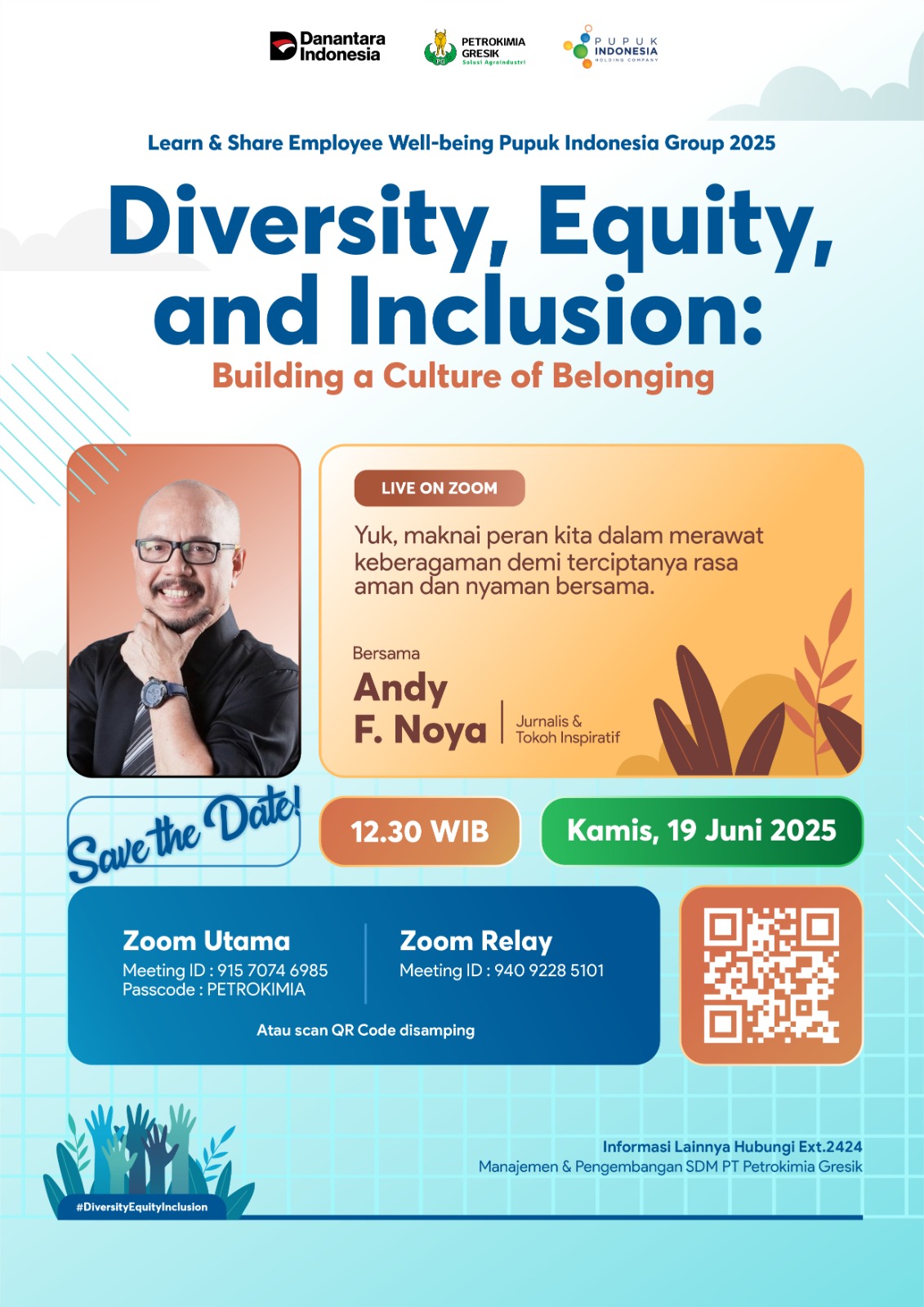
As part of these efforts, Pupuk Indonesia Group held the Learn & Share Employee Well-being program titled “Diversity, Equity, and Inclusion: Building a Culture of Belonging” on 19 June 2025, featuring Andy F. Noya as the speaker. The program serves as a learning platform for employees to raise awareness of the importance of diversity, understand differing perspectives, and foster mutual respect in workplace interactions. Through this activity, the Company encourages every employee to play an active role in nurturing diversity and creating a safe, comfortable, and inclusive work environment that supports a growing sense of belonging.
Pupuk Indonesia is committed to enhancing employee competencies and capabilities through structured and continuous learning and development programs. Competency development programs are implemented through various types of training designed to support the development of technical, managerial, and leadership competencies, as well as the Company’s business needs.
As part of its commitment to transparency in talent management, PTPI regularly monitors employee participation in competency development programs. PTPI’s 2025 Sustainability Report presents information on employee competency development, including training programs categorized by training type, gender, and employment status. To further strengthen information disclosure, the Company also presents a breakdown of training participation by management level and age group, as follows:
Number of Employees Participating in Training by Management Level
| Level | 2022 | 2023 | 2024 | 2025 | ||||||||
|---|---|---|---|---|---|---|---|---|---|---|---|---|
| Total | Male | Female | Total | Male | Female | Total | Male | Female | Total | Male | Female | |
| Grade 1 | 217 | 194 | 23 | 337 | 281 | 56 | 307 | 254 | 53 | 332 | 281 | 51 |
| Grade 2 | 696 | 612 | 84 | 916 | 738 | 178 | 1,192 | 915 | 277 | 1,111 | 873 | 238 |
| Grade 3 | 1,639 | 1,427 | 212 | 1,475 | 1,281 | 194 | 1,782 | 1,441 | 341 | 1,755 | 1,401 | 354 |
| Grade 4 | 1,997 | 1,739 | 258 | 2,487 | 2,029 | 458 | 2,362 | 1,900 | 462 | 2,237 | 1,871 | 366 |
| Grade 5 | 1,973 | 1,739 | 234 | 3,243 | 2,726 | 517 | 2,912 | 2,432 | 480 | 2,896 | 2,461 | 435 |
| Grade 6 | 1,003 | 963 | 40 | 848 | 781 | 67 | 1,035 | 996 | 39 | 1,303 | 1,221 | 82 |
| Grade 7 | 326 | 317 | 9 | 489 | 472 | 17 | 126 | 126 | 0 | 290 | 273 | 17 |
Number of Employees Participating in Training by Age Group
| Age Group | 2022 | 2023 | 2024 | 2025 | ||||||||
|---|---|---|---|---|---|---|---|---|---|---|---|---|
| Total | Male | Female | Total | Male | Female | Total | Male | Female | Total | Male | Female | |
| < 30 years | 1,782 | 1,585 | 197 | 2,283 | 1,921 | 362 | 2,052 | 1,639 | 413 | 2,098 | 1,740 | 358 |
| 30 - 50 years | 5,225 | 4,569 | 656 | 6,451 | 5,494 | 957 | 6,507 | 5,480 | 1,027 | 7,155 | 6,110 | 1,045 |
| > 50 years | 854 | 794 | 60 | 747 | 637 | 110 | 593 | 492 | 101 | 612 | 499 | 113 |
Support Facilities
Pupuk Indonesia places employee health and well-being as the main pillar in creating a productive and harmonious work environment. We provide work facilities that are clean and safe and support employees' mental and physical well-being. To help employees balance their professional and personal lives, the Company implements flexible working hours, including a Work From Home (WFH) system. In addition, supporting facilities such as lactation rooms and childcare are available to support the convenience of employees, especially parents. The Company also encourages employees’ physical health and mental health through health socialization in print media, health webinars/seminars, and the VIRAL (Virtual Running, Walking, and Cycling) program, as well as employee Sports Communities, including Diving, Running, Riding, Golf, Bicycle, Tennis, Basketball, Soccer, and others. These efforts aim to maintain employees’ physical and mental health, increase productivity, and support the sustainability and growth of the company.


Respectful & Inclusive Workplace Policy
Pupuk Indonesia's commitment to the Respectful & Inclusive Workplace Policy (RIWP) aligns with the Circular Letter from the Minister of State-Owned Enterprises No. SE-3/MBU/04/2022, which Pupuk Indonesia has ratified through the RWP guidelines policy PI-SDM-PD-009. The Respectful & Inclusive Workplace Policy emphasizes the importance of ethical behavior, equal opportunities, and the protection of employee rights, ensuring that each individual can work in a supportive environment, free from discrimination, harassment, or unsafe conditions. Under this policy, Pupuk Indonesia is committed to:
- Strictly prohibits all forms of sexual and non-sexual harassment, whether in daily interactions, written communications or in any context in the work environment.
- Zero tolerance for discrimination based on race, religion, gender, sexual orientation, age, disability, or other background, and strict disciplinary action be taken against individuals found to have committed harassment or discrimination.
- Raising awareness, providing a deep understanding of unacceptable behavior, and ways to report incidents of harassment and discrimination.
All employees are required to report incidents of harassment and discrimination directly to their supervisor or through anonymous reporting channels, with assurances of confidentiality and protection from retaliation.
Employee Performance Evaluation
Pupuk Indonesia implements an integrated performance management system to ensure that every employee has clear, measurable work objectives that are aligned with the company’s strategy. The Management by Objectives (MBO) approach is combined with Key Performance Indicators (KPIs) at both unit and individual levels, ensuring that personal contributions directly support the achievement of team and corporate targets.
In addition, to enhance objectivity, the company applies Multidimensional Performance Appraisal (360-degree feedback), which incorporates input from supervisors, peers, subordinates, and external stakeholders. This method provides a comprehensive overview of employee strengths and development areas. The Team-Based Performance Appraisal approach emphasizes collaboration, synergy, and collective results, thereby fostering a culture of mutual support and knowledge sharing across units.
To support continuous competency development, the company also adopts agile conversations as a form of real-time, dialogue-based coaching. Through open conversations, leaders can provide direct feedback, identify obstacles early, and adjust development plans according to employee needs.
By combining MBO, 360-degree feedback, team performance evaluations, and agile conversations, Pupuk Indonesia cultivates a fair, inclusive, and continuously improving work culture. This ensures that employees are not only focused on achieving individual targets but also contribute to team success and the company’s overall vision, while their individual contributions are duly valued.
Employee Experience Survey
Listening to Employees, Measuring Real Commitment
Pupuk Indonesia not only cares about its employees, but also measures their experience systematically every year since 2023, from recruitment through the end of their assignment, as part of the Human Experience Management Roadmap.
A total of 82 statements are assessed based on their level of impact and scale of implementation, covering meaningful work, strong management, positive workplace, health & wellbeing, growth opportunity, and trust in the organization.
Consolidated Results
| Year | Consolidated Employee Experience Score |
|---|---|
| 2024 | 82.75% |
| 2025 | 82.76% |
Scores consistently above 82% for two consecutive years indicate a stable and well-maintained employee experience.
Aspects Measured in the Survey
- Job Satisfaction The majority of employees are satisfied because their skills are effectively utilized, their roles are clearly understood, and they receive strong team support.
- Purpose The majority of employees perceive that the goals of their work and the objectives of their roles are aligned with the Company’s mission.
- Happiness Employees feel happy at work, supported by the Employee Well-Being Program, which addresses physical, mental, financial, and social wellbeing, as well as the Respectful Workplace Policy and the principles of DEI (Diversity, Equity, Inclusion).
- Stress The majority of employees do not experience work-related stress. Pupuk Indonesia continues to strengthen mental health and social support to foster a supportive work environment.
Employee Recruitment
Pupuk Indonesia implements a transparent and fair recruitment process that provides equal opportunities to all candidates based on their competencies and the Company’s workforce requirements. Talent needs are fulfilled through two recruitment channels: external recruitment to attract new talent from outside the Company, and internal recruitment through promotions and transfers as part of employee career development.
As part of its commitment to transparency in talent management, Pupuk Indonesia monitors recruitment performance, including the number of new employees hired through external recruitment and the number and percentage of positions filled by internal candidates. The profile of new employees by gender, employment status, age group, and region has been disclosed in Pupuk Indonesia’s 2025 Sustainability Report. The following information supplements this disclosure by presenting recruitment performance for the 2022–2025 period.
Employee Recruitment Performance
| Indicator | 2022 | 2023 | 2024 | 2025 |
|---|---|---|---|---|
| Number of new employees hired through external recruitment | 51 | 31 | 160 | 320 |
| Number of positions filled by internal candidates | 1,671 | 1,185 | 1,257 | 1,002 |
| Percentage of positions filled by internal candidates | 97.04% | 97.45% | 88.71% | 75.79% |
1. Human Rights
Commitment and Scope
PT Pupuk Indonesia (Persero) is committed to respecting and protecting human rights across all operational activities and business relationships. This commitment extends beyond permanent employees and covers:
- All employees: Permanent employees (PKWTT) and fixed-term contract employees (PKWT), including pregnant and breastfeeding employees, persons with disabilities, and employees approaching retirement age.
- The Company’s Business Ecosystem: Outsourced workers (TKAD), supported Micro, Small, and Medium Enterprises (MSMEs), vendors, farmers, and supply chain partners.
Human rights risk assessments consider the nature, scale, scope, and remediability of potential impacts. Assessment results are classified into three risk levels: low, medium, and high, to determine follow-up priorities and appropriate mitigation strategies.
Methodology and Review Frequency
The human rights risk map is systematically reviewed at least once a year and updated whenever significant changes occur in:
- Operational activities and business processes
- Technology and operational locations
- Regulatory requirements
- Value chain structures or business relationships
The results of these reviews are integrated into the Company’s risk management and decision-making processes and are used to continuously improve human rights protection policies and programs.
Human Rights Issues Assessed (Actual and Potential)
PT Pupuk Indonesia identifies and assesses actual and potential human rights issues relevant to its operations and value chain, including:
| Category | Human Rights Issues |
|---|---|
| Working Conditions | Forced labor and inadequate working conditions; child labor; occupational health and safety (OHS), including exposure to hazardous and toxic substances. |
| Equality and Non-Discrimination | Discrimination in recruitment, promotion, job assignments, remuneration, and career development; sexual harassment and gender-based violence; violations of maternity rights, maternity leave, breastfeeding rights, and access to lactation facilities. |
| Employment Relations and Protection | Unclear employment arrangements and termination without adequate compensation; unequal access to training, benefits, and social protection; employee mental health and well-being. |
| Business Relationships | Imbalanced contractual relationships that may adversely affect MSMEs and business partners. |
No Incidents of Child Labor or Forced Labor Identified in 2025
In 2025, Pupuk Indonesia conducted a comprehensive assessment of child labor and forced labor risks across its internal operations and supply chain. The assessment found no identified incidents or actual risks within internal operations, outsourced workforce arrangements, or the supply chain throughout 2025.
These findings reinforce the Company’s commitment to protecting fundamental labor rights in accordance with ILO Conventions C138 and C182, as well as applicable Indonesian labor regulations, including Law No. 21 of 2000 concerning Trade Unions, Law No. 2 of 2004 concerning Industrial Relations Dispute Settlement, and Government Regulation No. 35 of 2021 concerning Fixed-Term Employment Agreements, Outsourcing, Working Hours and Rest Periods, and Termination of Employment.
Grievance Mechanisms and Follow-Up Actions
Grievance channels are accessible to employees, customers, business partners, and external stakeholders. Reports supported by evidence are subject to fair examination and investigation, followed by corrective actions and sanctions in accordance with applicable regulations and Company policies. In 2025, no grievances related to human rights violations were reported.
The effectiveness of preventive and mitigation measures is monitored through seven mechanisms: (1) evaluation of human rights programs and policies, (2) internal and external audits, (3) analysis of stakeholder grievances, (4) employee dialogue and feedback, (5) supplier compliance assessments, (6) updates to human rights risk profiles, and (7) regular Bipartite Cooperation Institution (LKS Bipartit) meetings with labor unions. Monitoring results are used to continuously improve the Company’s human rights protection policies, procedures, and programs.
Human Rights Protection Programs and Policies
The Company’s commitment to human rights protection is implemented through the following programs and policies:
| Focus Area | Programs and Policies |
|---|---|
| Employees | Respectful & Inclusive Workplace Policy (RIWP), including anti-discrimination and anti-harassment policies with a zero-tolerance approach; maternity leave and comprehensive lactation facilities; PI Careline for mental health support; BPJS Health Insurance and Employment Social Security coverage for all employees, including fixed-term contract and outsourced workers; and reasonable accommodations and accessibility for persons with disabilities. |
| Supply Chain and Business Partners | Periodic assessments of labor service providers’ compliance with human rights and occupational health and safety (OHS) standards; inclusion of human rights and OHS compliance clauses in agreements with suppliers and partners; timely payments, capacity building, and assistance for MSME partners; and expansion of the PI Peduli program to the business partner ecosystem. |
| Product Users | Education for farmers on the safe use of fertilizers and provision of product-related grievance channels. |
2. Human Rights Due Diligence and Risk Assessment
Human Rights Due Diligence and Risk Assessment: 1,756 Rights Holders Assessed in 2025
In 2025, Pupuk Indonesia conducted a human rights risk assessment as an integral part of its human rights due diligence process to: (1) identify potential adverse impacts on rights holders, (2) determine relative risk levels, (3) prioritize mitigation measures, and (4) monitor the effectiveness of human rights protection programs.
The assessment covered all internal operational units and groups within the Company’s value chain, including outsourced workers from four service providers (PT Rekayasa Cakrawala Resources, PT Fokus Jasa Mitra, PT Yepeka Usaha Mandiri, and PT Ima Meukat Raya), workers at supplier facilities, vendors, distributors, transporters, farmers using the Company’s products, supported Micro, Small, and Medium Enterprises (MSMEs), and local business partners.
Scope and Results of Human Rights Risk Identification in 2025
The following table presents the scope of human rights risk identification across internal rights holders and the Company’s business ecosystem:
| Assessment Scope | Number Assessed | Risk Identification Coverage | Mitigation: BPJS & PI Careline |
|---|---|---|---|
| Permanent Employees (PKWTT) | 341 | 100% | 100% |
| Fixed-Term Contract Employees (PKWT) | 47 | 100% | 100% |
| Employees on Maternity Leave | 5 | 100% | 100% |
| Outsourced Workers (TKAD) | 1,363 | 100% | 100% |
| TOTAL INTERNAL + BUSINESS ECOSYSTEM | 1,756 | 100% | 100% |
The 100% risk identification coverage indicates that the human rights risk profiles of all rights holders within the defined assessment scope have been evaluated. The 100% mitigation coverage indicates that all assessed rights holders are covered by integrated social protection measures and mental health support services.
Human Rights Risk Identification Results
Human Rights Risks Mapped Transparently, with Mitigation Prioritized for the Highest-Risk Groups. Of the eight rights holder groups assessed, two were classified as high risk, five as medium risk, and one as low risk.
| Risk Level | Potentially Affected Groups | Key Human Rights Risks Identified |
|---|---|---|
| High | Outsourced Workers (TKAD) | Wage deductions, unequal occupational health and safety (OHS) protection, restrictions on freedom of association, and limited access to grievance mechanisms. |
| High | Supply Chain Workers (Vendors, Distributors, and Transporters) | Forced labor, inadequate working conditions, and exposure to hazardous and toxic substances (B3) without adequate personal protective equipment (PPE). |
| Medium | Female Employees (Pregnant and Breastfeeding) | Gender-based discrimination, sexual harassment, gender-based violence, and violations of maternity rights. |
| Medium | Fixed-Term Contract Employees (PKWT) | Unclear employment status, unequal access to employment benefits, and termination without adequate compensation. |
| Medium | Employees with Disabilities | Limited accessibility, discrimination in recruitment and selection, and barriers to career development. |
| Medium | Farmers Using Fertilizer Products | Occupational accident risks, chemical exposure, and limited access to information on safe product use. |
| Medium | MSMEs, Vendors, and Local Business Partners | Delayed payments and imbalances in contractual bargaining power. |
| Low | Older Employees and Employees Approaching Retirement | Marginalization in job assignments, unequal access to training, and insufficient preparation for the transition to retirement. |
Based on the risk mapping above, mitigation priorities are focused on high-risk groups, particularly outsourced workers (TKAD) and supply chain workers, through compliance assessments and industrial relations practices aligned with applicable labor regulations. For medium- and low-risk groups, preventive measures and ongoing monitoring are implemented in accordance with the Company’s business context and applicable regulatory requirements.
Implementation of PI Peduli and PI Careline Programs: Protection Reaching 2,462 Beneficiaries
The PI Peduli program is integrated with BPJS Ketenagakerjaan (Employment Social Security), while access to PI Careline (mental health support services) is available to all categories of rights holders. Participation in the PI Peduli Program as of December 2025:
| Indicator | Number |
|---|---|
| Active Donors (Employees) | 64 people |
| Internal Beneficiaries (Vulnerable Workers) | 662 people |
| External Beneficiaries (Ring 1/Surrounding Communities) | 1,800 people |
| Total Beneficiaries | 2,462 people |
All 1,756 internal rights holders have registered access to PI Careline, including permanent employees (PKWTT), fixed-term contract employees (PKWT), pregnant and breastfeeding employees, employees with disabilities, employees approaching retirement, and outsourced workers (TKAD). This ensures that no one is left behind in accessing mental health protection and support services.
Continuous Commitment and Improvement Roadmap
PT Pupuk Indonesia is committed to continuously enhancing the effectiveness and coverage of its human rights protection programs. In the coming years, the Company will focus on: (1) expanding BPJS Ketenagakerjaan coverage to all categories of outsourced workers without exception, (2) improving access to PI Careline by increasing service capacity and awareness across all operational locations, and (3) strengthening regular monitoring and evaluation of program effectiveness.
Through this integrated and holistic approach, PT Pupuk Indonesia ensures that human rights protection is not merely a regulatory compliance obligation but an integral part of the Company’s corporate culture and business strategy.