Sustainability
Sustainability Perfomance
Audits related to implementing environmental management following laws, regulations, permits, and/or standards have been carried out in Pupuk Indonesia's operational areas through external and internal audits. The implementation includes:
- ISO 14001 Environmental Management System All business units relevant to the implementation of the Environmental Management System have been certified with ISO 14001:2015, namely: Petrokimia Gresik, Pupuk Kujang, Pupuk Kalimantan Timur, Pupuk Iskandar Muda, Pupuk Sriwidjaja Palembang, and Rekayasa Industri.
- PROPER achievement, which assesses companies' compliance with environmental regulations, is conducted by the Ministry of Environment and Forestry (KLHK).
As part of its commitment to environmental preservation, Pupuk Indonesia consistently allocates investments to support sustainable environmental management. These allocations cover environmental maintenance, consulting, audit and permitting services, hazardous and non-hazardous waste management, environmental awareness enhancement, greening and conservation, as well as the provision of equipment and facilities for environmental management units.
The following table presents Pupuk Indonesia’s environmental investment data for 2022–2025:
| Description | Classification | 2025 (IDR Million) | 2024* (IDR Million) | 2023* (IDR Million) | 2022 (IDR Million) |
|---|---|---|---|---|---|
| Environmental Maintenance | Capital Investment | 4,609 | 4,221 | 2,398 | 8,466 |
| Consulting, Audit and Permitting Services | Operating Expenses | 18,124 | 14,936 | 13,304 | 10,801 |
| Hazardous, Non-Hazardous Waste and General Waste Management | Operating Expenses | 58,510 | 58,081 | 50,739 | 36,464 |
| Environmental Awareness Enhancement | Operating Expenses | 614 | 845 | 985 | 2,466 |
| Greening / Conservation | Capital Investment | 36,598 | 18,074 | 23,583 | 589 |
| Environmental Management Equipment / Units | Capital Investment | 20,141 | 40,648 | 73,079 | 9,851 |
| TOTAL | 138,596 | 136,805 | 164,088 | 68,637 | |
Pupuk Indonesia’s Return on Environmental Investments performance is presented as follows:
| Description | Unit | 2025 | 2024 | 2023 | 2022 |
|---|---|---|---|---|---|
| Capital Investment | IDR Million | 61,348 | 62,943 | 99,060 | 18,906 |
| Operating Expenses | IDR Million | 77,248 | 73,862 | 65,028 | 49,731 |
| Total Expenses | IDR Million | 138,596 | 136,805 | 164,088 | 68,637 |
| Savings, cost avoidance, income, tax incentives, etc. | IDR Million | 15,000 | 15,000 | 15,000 | 15,000 |
| Saving-to-Expenses Ratio | % | 10.82 | 10.96 | 9.14 | 21.85 |
The Company takes into account potential costs that can be avoided (cost avoidance) through the implementation of environmental management and compliance measures. The estimated cost avoidance is calculated using an approach based on potential administrative sanctions, with reference to Government Regulation No. 22 of 2021 concerning the Implementation of Environmental Protection and Management and Minister of Environment and Forestry Regulation No. 14 of 2024 concerning the Implementation of Supervision and Administrative Sanctions in the Environmental Sector. Assuming a potential fine of IDR 3 billion in each of the five operational areas, the Company’s total estimated cost avoidance amounts to IDR 15 billion.
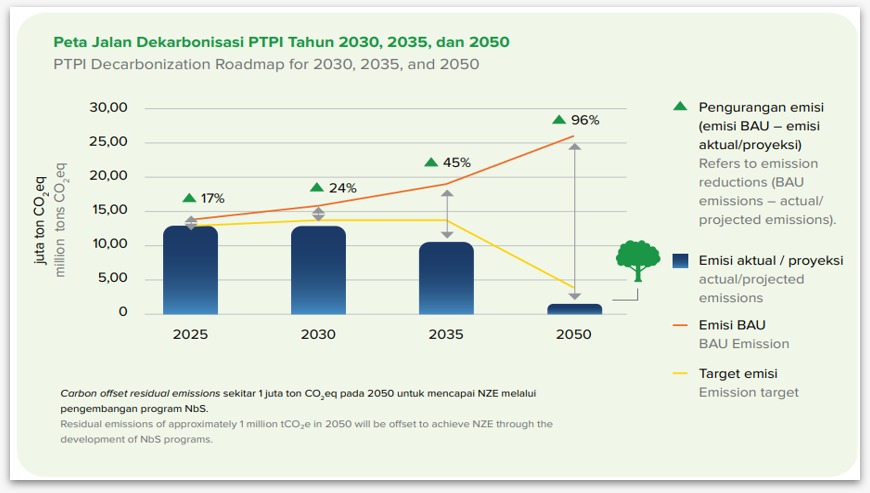
PTPI has established a Scope 1 and Scope 2 GHG emissions decarbonization roadmap featuring phased emission reduction targets compared to the BAU scenario. This roadmap includes a short-term target in 2030 with a 24% emission reduction from BAU, a medium-term target in 2035 with a 45% reduction from BAU, and a long-term target in 2050 with a 96% reduction from BAU, which is equivalent to achieving NZE. These targets are set against a 2010 BAU baseline of 12.89 million tons CO2eq.
Commitment to NOx, SOx, and COD Emission Targets
Pupuk Indonesia is strongly committed to complying with emission quality standards set by regulators regarding NOx and SOx emissions. These emission quality standards are adjusted according to the type of emission sources and the production processes carried out in each operational unit. This is explicitly regulated in the Regulation of the Minister of Environment and Forestry No. 17 of 2019 concerning Emission Quality Standards for Fertilizer Industry and Ammonium Nitrate Industry Activities. In addition, fertilizer production operations do not generate Volatile Organic Compound (VOC) emissions. Meanwhile, wastewater quality standards for the Chemical Oxygen Demand (COD) parameter are stipulated in wastewater disposal permits in each operational area.
In its implementation, Pupuk Indonesia consistently strives to meet the established standards. Through structured and sustainable emission and wastewater management programs, the company ensures that the emissions and wastewater produced never exceed the applicable quality limits. As tangible evidence of this commitment, Pupuk Indonesia has never received any sanctions or fines related to emission or wastewater violations.

Pupuk Indonesia ensures that employee awareness of the importance of water efficiency and water management is continuously strengthened. These efforts are carried out through a combination of internal training and awareness sessions, as well as educational campaigns targeting both employees and relevant stakeholders.
In practice, PTPI ensures that all employees involved in water management, including wastewater management, have received training and awareness sessions related to water management and pollutant load control in accordance with applicable procedures and standards. Employees with specific competencies and certifications in water management and pollutant load control are also assigned to ensure that each stage of the process is carried out in compliance with the relevant requirements.
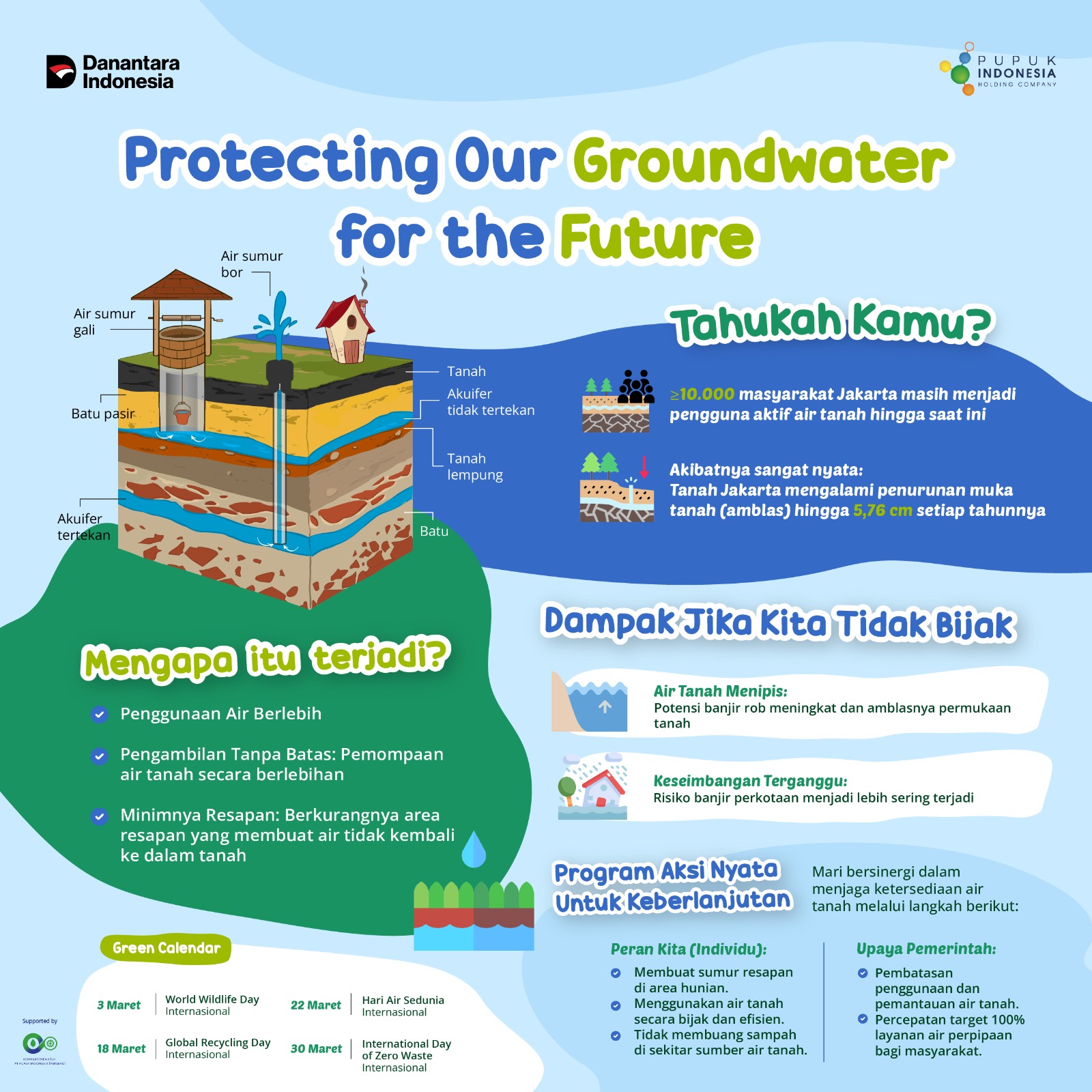
As part of its efforts to build broader awareness of the importance of maintaining water resource availability, particularly groundwater, Pupuk Indonesia Group has also initiated an educational campaign entitled “Protecting Our Groundwater for the Future.” The campaign materials provide information on the risks of excessive groundwater extraction, its impacts on land subsidence, and practical actions that can be taken by both individuals and organizations to support the long-term sustainability of groundwater resources. This initiative also helps strengthen employees’ understanding and awareness of sustainable water management issues.
Through a combination of competency-based technical training and awareness-building educational campaigns, PTPI seeks to ensure that efficient and responsible water management becomes an integral part of the work culture across all levels of the organization.
In addition to strengthening this work culture, Pupuk Indonesia Group’s commitment to efficient water management is also reflected in water withdrawal targets established for each water source. For 2025, the total water withdrawal target was set at 151,376,336 m³, with the largest share coming from surface water and desalinated seawater used for process requirements. Groundwater withdrawal was targeted at 3,351,898 m³, representing a relatively small proportion of the total target, in line with the Company’s attention to the risks associated with excessive groundwater extraction, as highlighted in the educational campaign described above. Details of the 2025 water withdrawal targets by source are presented in the following table.
| Source | Total (m³) |
|---|---|
| Groundwater | 3,351,898 |
| Surface water (rivers, lakes) | 80,483,539 |
| Rainwater | 3,900,000 |
| Seawater (desalinated) for process use | 62,562,124 |
| Water from third parties (PAM, PDAM) | 1,078,775 |
| Total | 151,376,336 |
Water Risk Management Programs
As part of its commitment to sustainable water resource management, Pupuk Indonesia Group conducts a Water Risk Assessment to identify and evaluate potential risks arising from its operational dependence on water availability and quality (dependency-related water risks), as well as the potential impacts of water use on the environment and surrounding communities (impact-related water risks).
The assessment is conducted using the WWF Water Risk Filter (WRF) v3.0 and WRI Aqueduct Water Risk Atlas, covering physical, regulatory, and reputational risks at both the basin and operational levels. The assessment covers the operations of five Pupuk Indonesia Group subsidiaries, taking into account potential changes in future water availability and quality, impacts on local stakeholders, and developments in water-related regulations.
The assessment results serve as a basis for Pupuk Indonesia Group to determine mitigation priorities and strengthen water risk management strategies tailored to the specific characteristics of each operational location.
Water Risk Assessment Pupuk Indonesia Group 2026Waste Management Internal Audit
The waste management system within Pupuk Indonesia requires the waste generated to be processed before being discharged into licensed water bodies to not exceed the quality standards set out in the laws and regulations. Solid waste sent to landfills must be managed by licensed and certified third parties. To ensure that the Company's waste management practices are in accordance with the requirements of laws and regulations, waste management activities are carried out by employees with competency certification in accordance with aspects of waste management.
Waste Management
Pupuk Indonesia is responsible for managing waste, including solid waste. To ensure that waste management complies with applicable regulations, the company collaborates with the Environmental Agency, which also functions as a regulator. By entrusting waste management to competent parties and in accordance with government regulations, Pupuk Indonesia ensures that all waste management activities comply with the prevailing laws and contribute to environmental sustainability.
Investment in Innovation and Research & Development to Minimize Waste
Pupuk Indonesia Group views innovation as one of the key means of minimizing waste generation from operational activities. Through its subsidiaries, the Group allocates resources in the form of budgets, workforce, and technical support to explore new ideas and technologies aimed at reducing waste at the source. The scope covers hazardous and toxic waste (B3), liquid waste, and non-B3 waste. Several waste reduction innovations developed across the Group include:
- Auto Block Sistem Isolator (ABSI), PT Petrokimia Gresik: implementation of ABSI technology on the reformer vessel at the Ammonia Plant. This technology prevents carbon deposit formation caused by gas passing, thereby reducing hazardous nickel catalyst waste.
- CO₂ Decoking, PT Pupuk Kalimantan Timur: development of a decoking process using CO₂ to reduce spent hazardous catalyst waste.
- Utilization of Residual H₂SO₄ Reagent from Quality Control, PT Pupuk Iskandar Muda: reuse of residual sulfuric acid reagent from quality control activities to reduce hazardous laboratory waste.
- Air BERGUNA, PT Petrokimia Gresik: utilization of water from the condensate treatment process as water scrubber feed at Urea Plant 1 to reduce liquid waste.
- Loading Deck System, PT Pupuk Kujang: implementation of a loading deck system to reduce urea spillage waste.
- Daur Ulang Karung Bekas, PT Pupuk Kujang: recycling of used sacks as part of the 3R (reduce, reuse, recycle) program for non-hazardous waste.
- FABULOUS (FABA for Underwater Life and Ocean Bio-Reef Sustainability), PT Pupuk Kalimantan Timur: utilization of fly ash and bottom ash (FABA) as bio-reef material.
Energy Efficiency: Integrated Education and Supervision
Pupuk Indonesia actively raises employee awareness regarding energy reduction through training, internal campaigns, and regular energy audits. This program is implemented across all relevant subsidiaries and includes:
- Training and socialization of energy efficiency for operational and managerial employees
- Internal energy audits to identify potential savings and performance improvements
- Technical capacity building through advanced training and certification in the field of energy

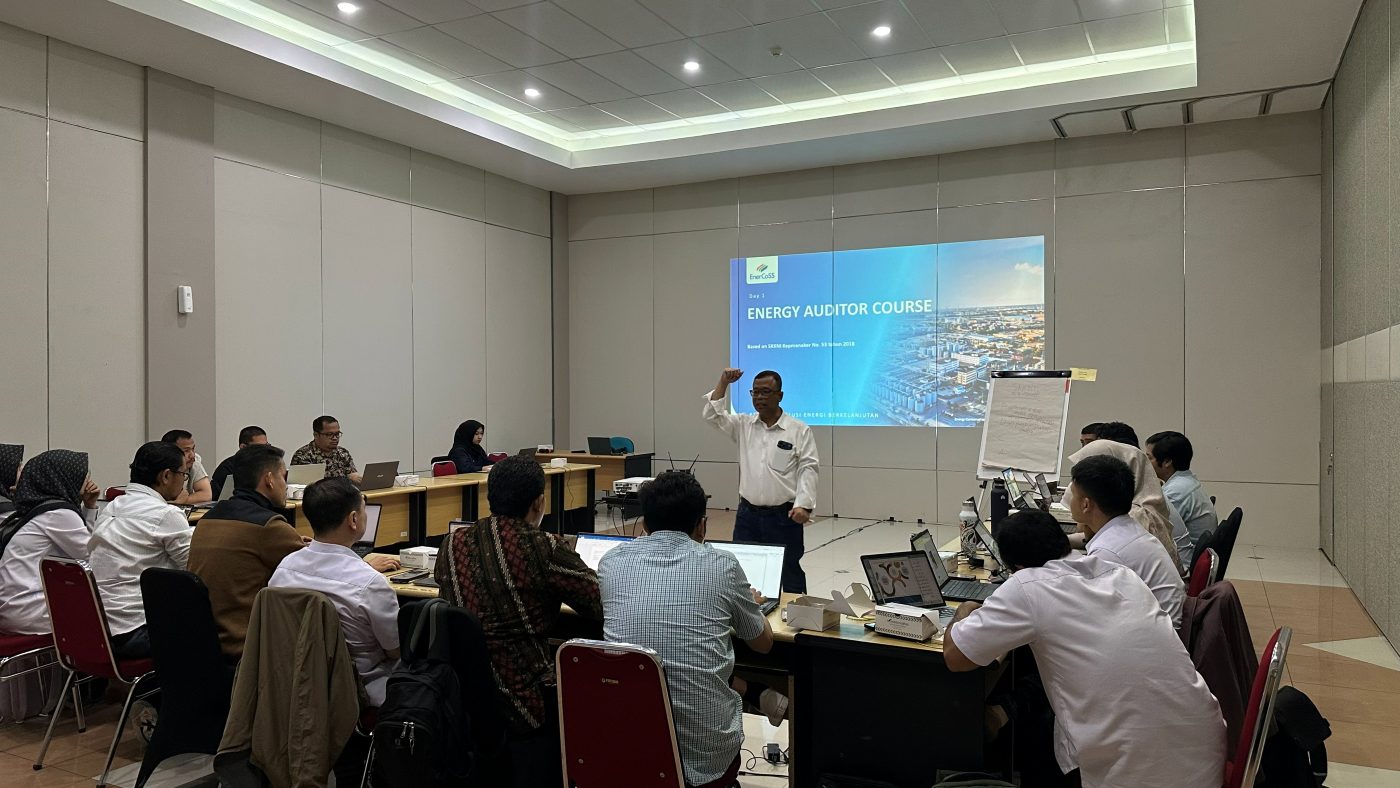
Training programs conducted include ISO 50001:2018 Energy Management System Internal Auditor Training and the Energy Auditor Course for employees. These programs equip participants with an understanding of energy management system implementation as well as the technical competencies required to conduct energy audits.
These initiatives support the Company’s sustainability targets and promote an energy-efficient work culture across Pupuk Indonesia Group.